
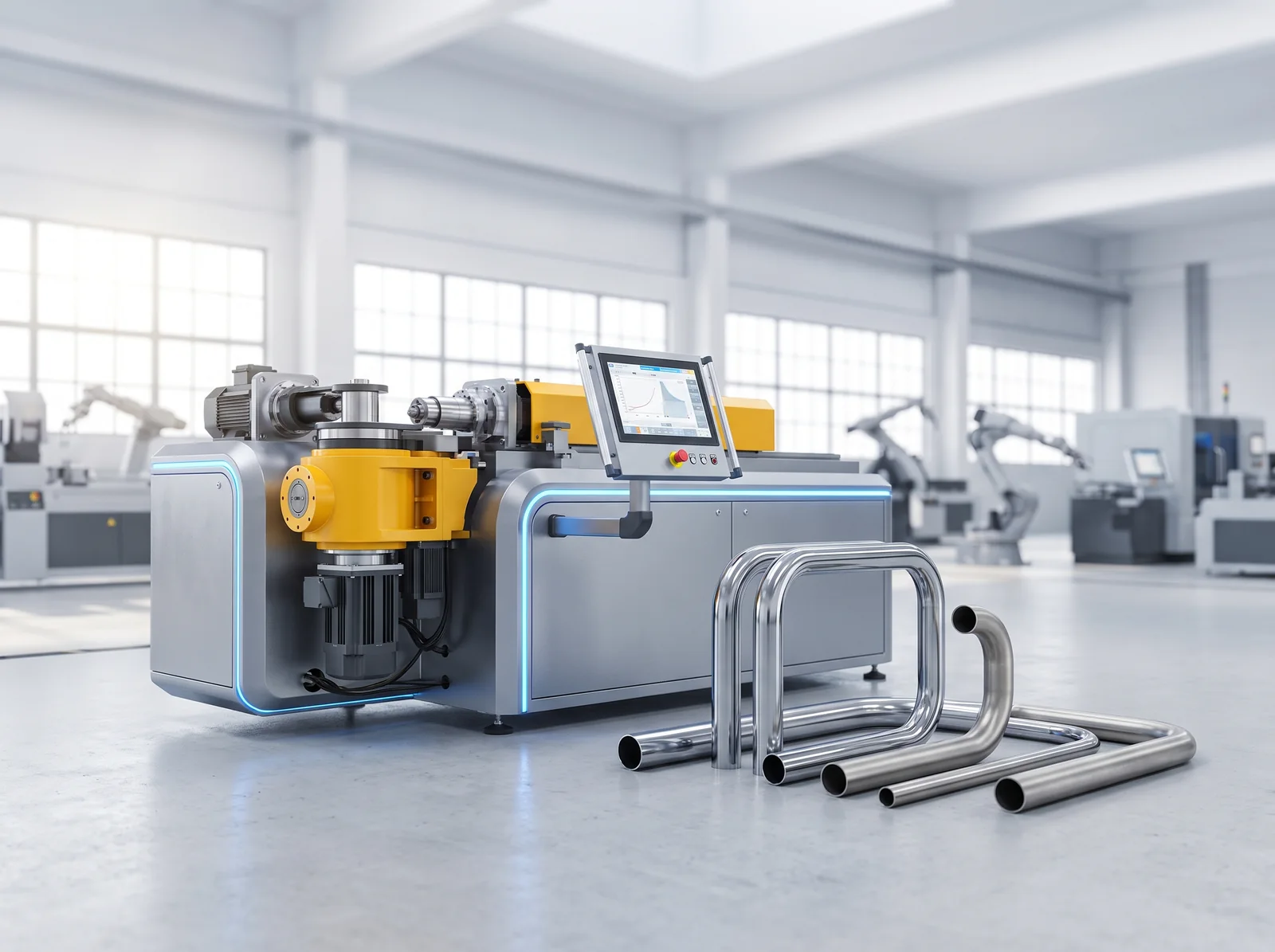
Buying a tube bending machine is a serious investment, and the right choice depends far more on the parts you make than on any single spec sheet. A machine that is perfect for thin-wall automotive fuel lines may be completely wrong for heavy structural pipe — and paying for CNC capability you never use is just as costly as buying a machine that cannot hold your tolerances. This guide walks through how to choose the right tube bending machine for your work, based on more than 30 years of building them.
Start With the Part, Not the Machine
Before you compare a single brand, write down four things about the parts you actually bend:
- Tube diameter and wall thickness. A Ø12 mm brake line and a Ø150 mm structural pipe need very different machines. Wall thickness matters as much as diameter — thin wall is harder to bend cleanly than thick wall.
- Material. Mild steel, stainless, aluminium and copper all behave differently. Stainless work-hardens; copper tears easily; thin-wall aluminium wrinkles without support.
- Bend complexity. Are all your bends in one plane (2D), or does the tube twist through several planes (3D)? 3D parts need controlled rotation between bends.
- Volume. A job shop running ten different parts a week has different needs from a plant stamping out the same exhaust component fifty thousand times.
Those four answers point you straight at the right category of machine.
CNC, Hydraulic, Semi-Auto or Automatic?
This is the core decision, and it is really a question of how much of the bending cycle the machine controls versus the operator.
Full CNC — when tolerance and complexity are high
On a CNC tube bender every geometry-defining axis runs on a servo motor, and the whole part is programmed and simulated before any metal is cut. This is the right choice for tight tolerances, complex multi-bend parts, and production that has to be documented and repeatable. DuralBend offers two CNC platforms: the Griffin Hybrid CNC, which pairs servo accuracy with hydraulic clamping force for tube up to Ø170 mm, and the EOS Full Electric CNC, which runs every axis on servo motors with no hydraulics at all — ideal for small-diameter, thin-wall and clean-room work.
Hydraulic NC — when the job is simpler and cost matters
Not every part needs CNC. If you bend the same handful of parts repeatedly, mostly in 2D, an NC-controlled hydraulic machine like the Atlas B gives you reliable mandrel bending at a fraction of the cost, in eleven models from Ø32 mm to Ø170 mm.
Semi-automatic and automatic — the steps in between
Between the two extremes sit two useful options. The Atlas BR semi-automatic adds a servo rotation axis to the hydraulic platform, so you get repeatable 3D bends without paying for full CNC. And the Atlas BRF automatic runs feeding, rotation and bending hands-free on PLC control — the operator just loads and unloads, which is exactly what high-volume production needs. For symmetrical parts, the Gemini double head bends both ends of a tube in one pass.
Why Mandrel Bending Matters
If you bend thin-wall tube, mandrel support is not optional. A mandrel is a tool inserted inside the tube that holds the wall from collapsing or wrinkling on the inside of the bend. Without it, thin-wall tube flattens, the cross-section restricts flow, and the part fails. Every DuralBend bending machine supports mandrel, wiper die and pressure die tooling as standard — which is what lets them bend thin-wall tube cleanly where cheaper machines cannot.
Match the Machine to Your Industry
Different sectors push tube bending in different directions, and the right machine reflects that:
- In the automotive industry, tight tolerances and high volume dominate — exhaust, fuel and brake lines.
- In HVAC and refrigeration, it is all about clean, tight-radius bends in soft copper.
- In furniture manufacturing, symmetrical frames and visible finish quality drive the choice.
- In aerospace, thin-wall alloy and high-integrity, traceable bends are the priority.
- In shipbuilding, it is large-diameter, heavy-wall pipe and the power to bend it.
Do Not Forget Tube-End Processing
A finished part is rarely just a bent tube. Cut ends need deburring before they go into a bending machine, or they damage the mandrel and wiper die. Many parts need their ends chamfered for welding, or formed — reduced, flared, beaded — to mate with the next component. Planning for the deburring, chamfering and end forming steps up front saves a great deal of rework later.
A Simple Decision Checklist
- Largest tube diameter and thinnest wall you need to bend
- 2D bends only, or 3D multi-plane parts?
- How many different parts, and at what volume?
- Do your tolerances or contracts require documented, repeatable production?
- Which materials — and do any of them need mandrel support?
- What end processing (deburring, chamfering, forming) does the finished part need?
Answer those six honestly and the right machine usually chooses itself.
Frequently Asked Questions
What is the difference between a tube bender and a pipe bender?
In practice the terms are used interchangeably. “Tube” tends to refer to thinner-wall product specified by outside diameter, and “pipe” to heavier-wall product specified by nominal bore, but the same machine often bends both. What matters is the diameter, wall thickness and material you actually run.
Do I need a CNC tube bending machine?
Only if your parts justify it. CNC is worth it for complex 3D geometries, tight tolerances, and production that must be documented and repeatable. For simple 2D parts in modest volumes, a hydraulic NC machine does the job at a much lower cost.
Can one machine bend different tube sizes?
Yes, within its capacity range and with the right tooling. Quick-change tooling lets you switch between tube sizes, but every machine has a maximum diameter and wall thickness — which is why sizing the machine to your largest part matters.
Talk to a Manufacturer, Not Just a Catalogue
The best way to choose is to send your part drawing or a sample to a manufacturer who actually builds the machines. At DuralBend we have been manufacturing tube and pipe bending machines in Istanbul since 1991, and we will recommend the configuration that fits your part, your material and your volume — not the most expensive machine on the list. Browse our full range of bending machines, or email info@duralbend.com or call +90 212 482 41 07.